
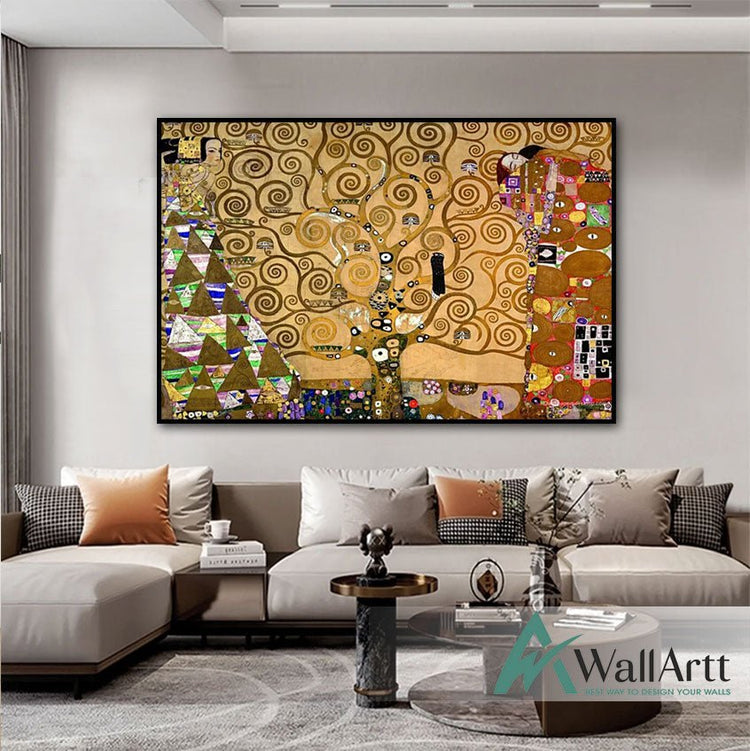
Few paintings are as instantly recognisable as Gustav Klimt's The Tree of Life. Its swirling golden branches, tiny eye-like symbols and lone black bird have made it one of the most loved images of the early 20th century – and one of the most popular choices for wall art in UK homes today. In this guide we explain where the artwork comes from, what its symbols are often said to mean, and how to style a textured Tree of Life painting so it looks its best on your wall.
Where does The Tree of Life come from?
The Tree of Life was not originally a stand-alone painting. Klimt created it as part of a design for a large mosaic frieze in the dining room of the Palais Stoclet, a private mansion in Brussels built for the Belgian banker Adolphe Stoclet by the architect Josef Hoffmann and the Wiener Werkstätte. Klimt worked on the designs in the years around 1905–1911, during what is known as his Golden Period.
His full-size working drawings were turned into a mosaic by skilled craftsmen using materials such as marble, enamel, coral, semi-precious stones and gold. The frieze runs along the dining room walls in three main parts: a female figure known as The Expectation, the great spiralling Tree of Life, and an embracing couple known as The Fulfilment. Klimt's original designs are now held by the MAK (Museum of Applied Arts) in Vienna.
What does The Tree of Life symbolise?
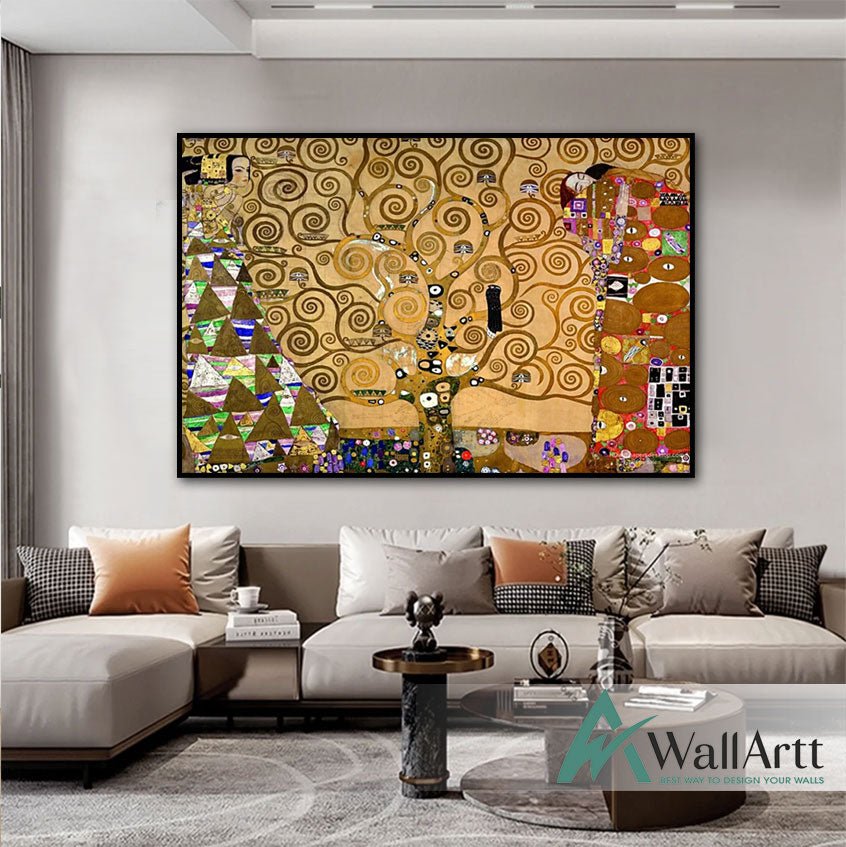
The tree of life is an ancient symbol found in many cultures, usually linking the heavens, the earth and the world below. Klimt drew on this idea and gave it his own decorative style. Common interpretations include:
- The spiralling branches: often read as the endless cycle and continuity of life, growing and connecting in every direction.
- The black bird: perched alone among the branches, it is frequently seen as a reminder of death – the natural counterpart to life.
- The eye-like motifs: small almond shapes scattered along the branches, often compared with ancient Egyptian symbols of protection.
- The gold: a sign of value, warmth and the sacred, inspired partly by the Byzantine mosaics Klimt admired in Ravenna.
Because the image combines growth, connection and family roots, many people choose it as a meaningful piece for a family home, a new house or a wedding gift.
Why it suits modern UK interiors
Klimt's design works surprisingly well in contemporary homes. The warm golds sit comfortably with today's earthy palettes – cream, taupe, sage, terracotta and deep teal – and the strong central shape gives a room an instant focal point. It also bridges styles: it feels at home in a Victorian terrace with period features and in a minimalist new-build flat.
How to style a Tree of Life painting at home
Living room
Hang it above the sofa as a single statement piece, roughly two-thirds of the sofa's width. Pair it with cream or warm grey walls and a few gold or brass accents, such as a lamp base or mirror frame, to echo the painting. Our guide to wall art above a sofa explains sizing and height.
Bedroom
Above the bed, the spiralling branches feel calm and enveloping. Soft neutral bedding lets the gold take centre stage; leave 20–25 cm between the headboard and the bottom of the frame.
Dining room and hallway
Fittingly, the design was created for a dining room, so it makes a natural talking point above a sideboard. In a hallway, a narrower size adds warmth to an otherwise plain wall.
Lighting
Gold and texture come alive with side lighting. A warm-white (2700–3000K) LED picture light or wall washer will bring out the raised paint and metallic tones. See our guide to lighting textured art.

What is a textured Tree of Life painting?
At WallArtt, our Klimt pieces are textured partial paintings. The design is printed on high-quality canvas, then our artists hand-finish the key areas – the spirals, the gold and the highlights – with acrylic paint, adding real raised texture. The result has far more depth than a flat print, catches the light as the day changes, and arrives stretched and ready to hang, with optional gold, black, silver, white or antique gold frames.
Other Klimt paintings that pair well
- The Kiss – Klimt's most famous golden embrace.
- The Golden Apple Tree – a softer landscape with the same golden glow.
- Death and Life – a dramatic companion to the Tree of Life's themes.
- Lake Garda – one of Klimt's calm, square-format landscapes.
For more ideas, read From Van Gogh to Klimt: bringing famous painters' art into your home.
Frequently asked questions
Who painted The Tree of Life?
The Austrian artist Gustav Klimt (1862–1918) created The Tree of Life as part of his designs for the Stoclet Frieze in Brussels, during his Golden Period.
Where is the original Tree of Life?
The finished mosaic is in the dining room of the Palais Stoclet in Brussels, which is a private house. Klimt's design drawings are held by the MAK in Vienna.
What does the bird in The Tree of Life mean?
The single black bird is commonly interpreted as a symbol of death, balancing the theme of life and growth shown by the spiralling branches.
What size Tree of Life painting should I buy?
Above a standard UK three-seater sofa or a double bed, a width of around 100–150 cm works well. For hallways and smaller walls, choose a medium size. Our size guide has a full chart.
Is the Tree of Life a good gift?
Yes. Its themes of family, roots and growth make it a popular gift for weddings, anniversaries and new homes. Delivery is free across the UK, and returns are unconditional within 14 days.
Related reading
- Cream and gold wall art: styling ideas
- Monet's Water Lilies: the story behind the paintings
- From Van Gogh to Klimt: famous painters at home
- Textured partial paintings: a new dimension in art
- How to light textured art
Explore our best sellers, see what is new in, or read our FAQs.
